How Teams Can Avoid Narrow LLM testing
The most significant risks in an enterprise AI-enabled service are not always immediately apparent.
Testing AI-enabled services often starts with the most visible questions. Does the system hallucinate? Is the answer accurate? Is it relevant to the user’s query? If the results look reasonable, it can be tempting to treat the service as ready, or close to it.
Those are sensible starting points. But treating them as sufficient is where false confidence starts.
Why teams start there
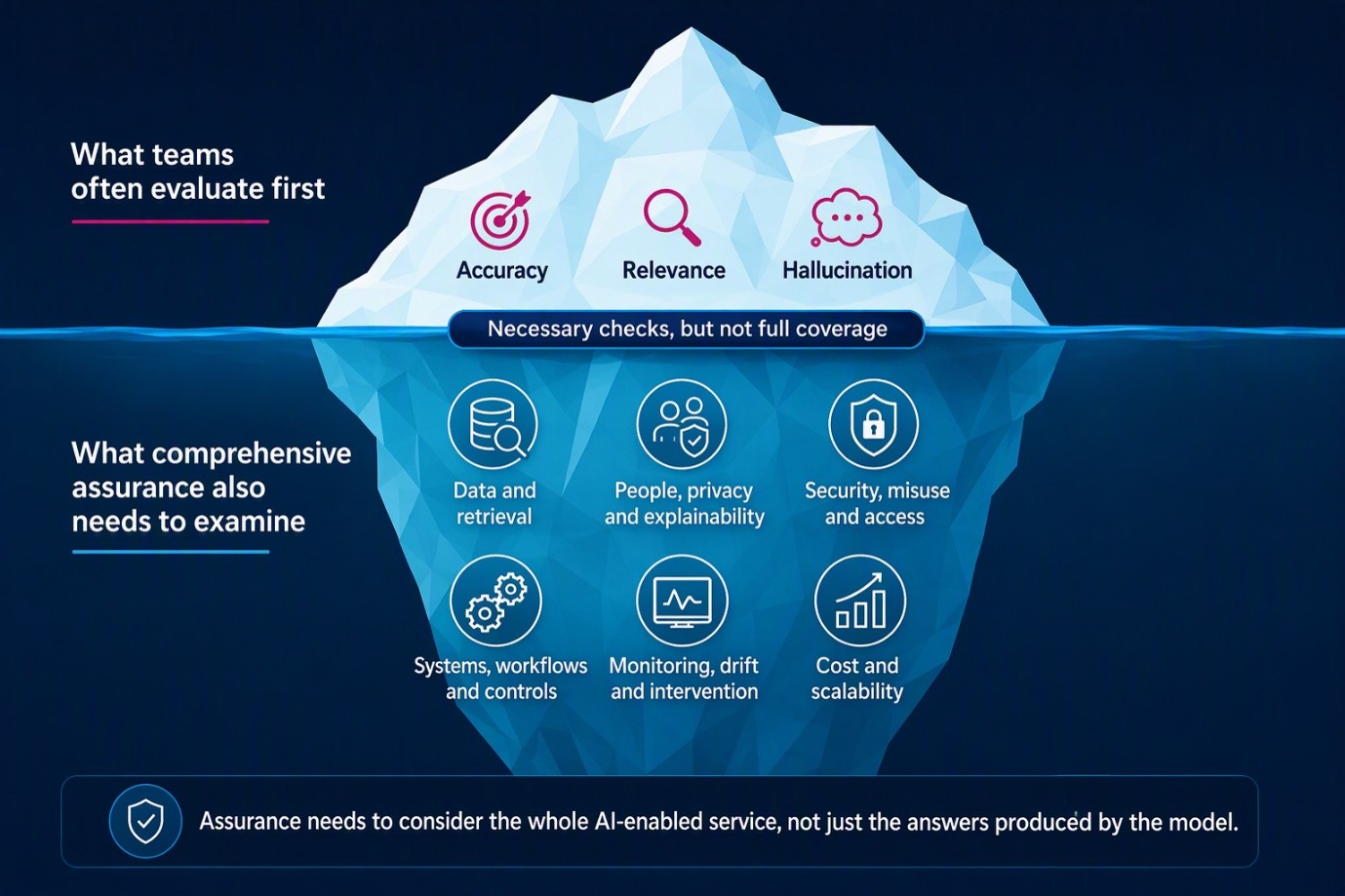
Hallucination, accuracy and relevance are among the most visible areas teams evaluate. For a chatbot, this may mean asking a question, reading the answer and deciding whether it is right and on-topic. No special tooling, no complex investigation, no difficult conversation about what evidence is needed. These are also the risks that are most straightforward to demonstrate in a short walkthrough.
That visibility is useful, but it is not the same as coverage. The risks that are easiest to observe are not necessarily the ones that cause the most damage. Even a model that performs well on hallucination and relevance checks can still expose a customer’s data, treat two similar people differently, or be manipulated by instructions hidden inside a document it was asked to summarise. Those risks are not addressed by asking only, “Was that answer correct and relevant?” As a result, they can be missed without anyone doing anything wrong.
Enterprise AI risk is wider than the surface conversation. It sits across the model, the data and retrieval layer, the surrounding systems, the workflows and controls, the downstream processes, and the way failures are detected, investigated and contained in production.
Correctness runs deeper than the visible answer
Factual accuracy is often the first thing teams test for, but grounding determines whether that accuracy is reliable or accidental.
In a Retrieval-Augmented Generation (RAG) system, the model is only as reliable as what it retrieves. If the retrieval step pulls the wrong document, an outdated version, or nothing relevant at all, the model may still produce a fluent, confident answer that appears to be well supported. Testing the output without testing what fed it checks the wrong layer.
People and trust are harder to see than they are to test
Bias and fairness, privacy, and explainability are also part of the wider AI evaluation landscape. They are often less visible because they involve the system’s relationship with the people affected by it, not just the task directly in front of it.
Does changing a name or a postcode change the recommendation? Can the system be asked to reveal information it should have withheld? If a decision is challenged, can anyone reconstruct why it was made? These questions rarely come up in a functional walkthrough because nothing about them looks broken until someone specifically goes looking for it. That is often when they surface: during an audit, through a complaint, or when someone affected challenges the outcome.
The attack surface is bigger than the chat window
A public-facing chatbot, or a RAG system built on uploaded or third-party content, has an attack surface that is easy to underestimate. Prompt injection does not need a hostile user typing directly into the chat window. Instructions hidden inside a retrieved document can hijack a response just as effectively.
Security and sovereignty raise further questions. Where is the data processed? Who can access it? Do tenant boundaries hold? Does the wider service behave safely when something unexpected happens? None of this is visible from the interface alone, which is why it can fall between testing, infrastructure and security teams when it really belongs across all three.
What passes today can fail tomorrow
Some risks only appear over time. Models drift, prompts are changed, source content is updated, providers alter behaviour upstream, and a system that passed every check at launch can degrade later.
Continuous monitoring is what turns “tested” from a description of one point in time into an ongoing view of how the service behaves in production.
Cost presents a related production risk. Token consumption, repeated inference, growing context windows or agent-style loops may look manageable during a pilot but become difficult to operate economically at scale. The issue is not simply whether the service is expensive. It is whether usage patterns could make it unsustainable, unreliable or inconsistent with the business case against which it was approved.
The false confidence problem
None of this means hallucination, accuracy and relevance testing are wasted effort. They are necessary checks, but they are not sufficient on their own. The danger is the confidence those results can create. It is tempting to interpret them as evidence that the wider service is safe, when they may show only that its most obvious behaviours have been assessed.
These less visible risks tend to surface later, in an audit, a complaint, an incident, a failed control, or a bill nobody budgeted for. This happens when the scope of testing is shaped by what can be readily assessed rather than by what could actually go wrong.
The fix is not simply a longer checklist. It is asking better questions earlier: What could go wrong? How would we know? And could we intervene when it does?
About the author
Raluca Xanthos is a Senior Technical Assurance Consultant at Acutest, specialising in AI quality engineering, test automation, and modern quality engineering practices. She works with organisations across the public and private sectors to improve software quality, accelerate delivery, and embed assurance throughout the development lifecycle.
If you would like to find out more on this article, or the wider work that Raluca does at Acutest for our clients, please feel free to email us at enquiries@acutest.com
Disclaimer: The words, thoughts and opinions are the author’s own. Generative AI was used to support the editing process.